
> THE PROBLEM WITH PRE-PACKAGED LESSONS
I've tried just about every language learning app out there. Duolingo, Babbel, Rosetta Stone, Pimsleur, plain Anki. They all make the same basic mistake: they decide what you learn, when you learn it, and in what order.
Here's what the linguistics research says, and it matches everything I've seen as a computational linguist: motivation is what drives acquisition. You don't pick up vocabulary by force-feeding yourself lists. You pick it up in contexts that matter to you. A song you love. A conversation about your work. A news article that makes you angry.
So the best language learning platform wouldn't hand you pre-packaged lessons. It would give you multi-sensory content you actually care about — audio, video, text, conversation — and then help you pull the language out of it.
> ACQUISITION IS CYCLES
The idea I built Allomorpheus around is simple: language acquisition runs in cycles of lexical acquisition and generalization.
In the acquisition phase, you run into new words in contexts that mean something. A song. An article. Something your AI tutor says in conversation. You save them to your personal vocabulary. This is where Anki-style spaced repetition earns its keep — not as isolated flashcard drills, but as a system that resurfaces a word right when you're about to forget it.
In the generalization phase, you take those words and push them into new contexts. You use them with your AI tutor. You spot them in a different song. You notice a pattern you already know showing up inside a new grammatical structure. That's when the language stops being something you study and starts being something you use.
The two phases feed each other. The more you acquire, the more patterns you notice. The more patterns you notice, the faster you acquire. It's not a straight line. It's a spiral.
> GROUNDING IN CONTENT THAT MOTIVATES YOU
Motivation isn't a personality trait. It's situational. It shows up when the material connects to something you actually care about.
That's why Allomorpheus is built around content you choose. Connect songs you already love to the music study tool and the lyrics line up with the audio automatically. Talk about whatever interests you in the AI conversation tool. Import articles from anywhere on the web into the reading tool. It all feeds into the same system.
When I study Japanese, I don't start with "hello" and "goodbye." I start with the lyrics of a YOASOBI song I've had on repeat for months. I save words I actually want to use. I talk to my AI tutor about computational linguistics and video games, because those are the things I care about. Every word lands in a context that matters to me.
That's the difference between a free language learning experience that works and one that fizzles out in a week. Motivation isn't optional. It's the whole substrate.
> YOUR PERSONAL LEXICON IS EVERYTHING
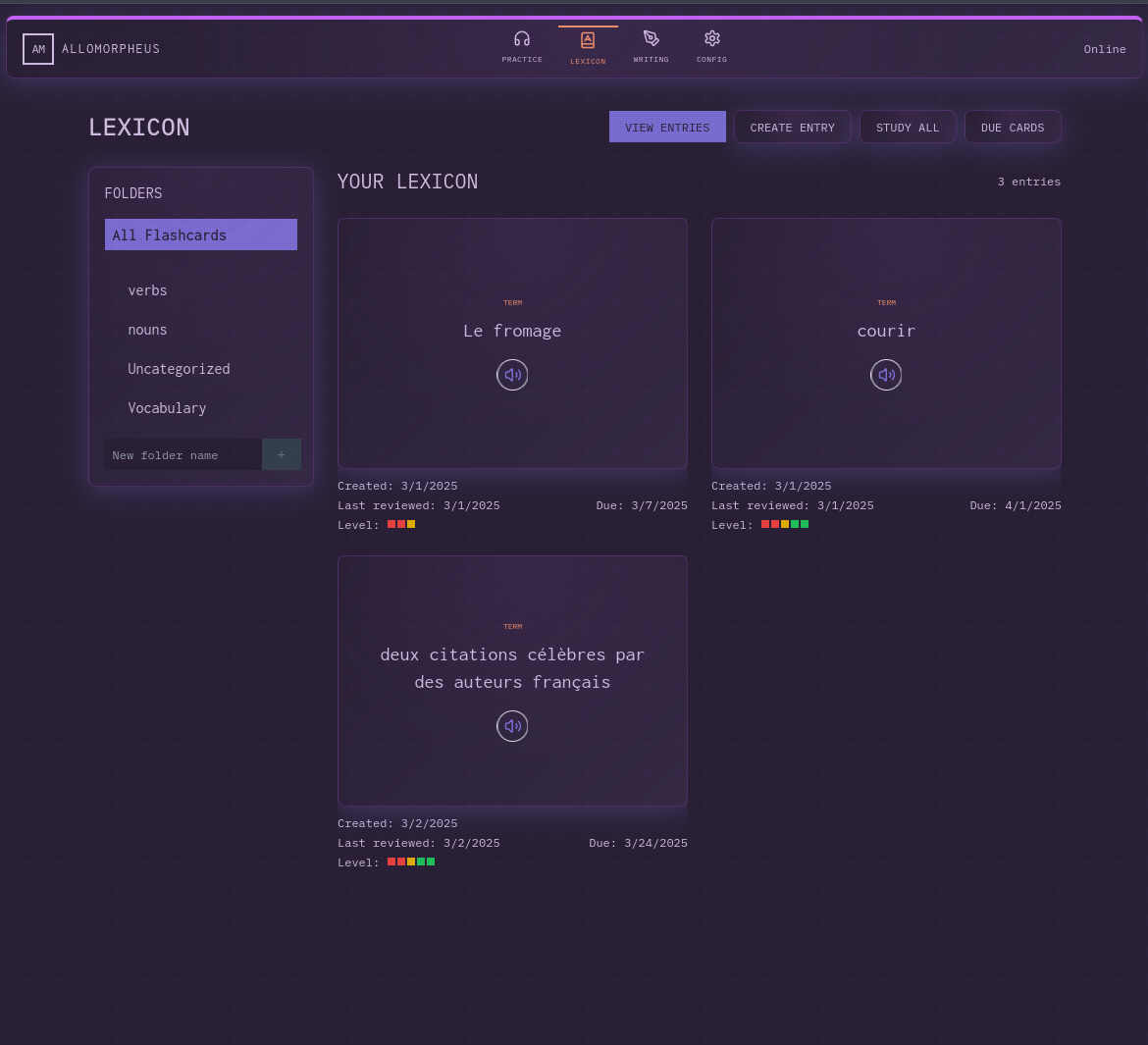
If vocabulary is the core activity of language learning — and it is — then everything should revolve around your personal collection of words. That one design decision shapes the entire Allomorpheus architecture.
Every word you save — from a conversation, a song, an article — goes into your personal lexicon. Multiword expressions too, grammatical patterns too. It isn't a pre-packaged list the platform forces on you. It's your vocabulary, grown out of your interests, organized the way you think about language.
Everything else flows from there. You build custom quiz sets to hammer the weak words. You export Anki flashcards with one click, in standard Anki format, ready for spaced repetition. Your AI tutor pulls from your lexicon to reinforce words you're still shaky on. Your grammar lessons get generated from the patterns in words you've actually run into.
The lexicon isn't a feature. It's the center of gravity.
> EXPLORING LANGUAGE STRUCTURE VERTICALLY
Most apps teach language horizontally. Lesson 1, lesson 2, lesson 3, each a little harder than the last. But language isn't horizontal. It's vertical.
At the top you have discourse: how conversations flow, how arguments are put together, how stories build and resolve. In the middle, phrases and multiword expressions — the chunks native speakers handle as single units. Below that, words. Except a word is never just a word; it carries tense, aspect, mood, case. And at the bottom, morphs — the smallest meaningful units. Roots, affixes, particles, verb endings.
When you're immersed in a real conversation, you're processing all of these levels at once. But when you study — when you're doing the deliberate work of acquisition — you get to zoom in and out. You can look at a single verb ending and figure out why it carries past perfective meaning. You can look at a whole conversation and see how topic-comment structure works in Japanese. You can look at a multiword expression and just learn the idiom.
This is what I call vertical exploration, and it's how I actually use Allomorpheus. I'm listening to a song in Japanese. I tap a word. The platform shows me the morphological breakdown: the root, the honorific prefix, the aspect marker, the sentence-final particle. I save the word. Then I look at the phrase it appears in — anata ni aitai — and see that the whole expression is a common multiword unit meaning "I want to see you." Then I zoom out and read the verse as a discourse unit, watching how the themes build across the song.
That's the language learning platform I wanted, so I built it. Not horizontal lessons. Vertical exploration.
> MY ACTUAL WORKFLOW
Here's what a typical week actually looks like:
01. IMMERSE
I spend at least 30 minutes a day in immersion. Sometimes that's a conversation with my AI tutor about something I care about. Sometimes it's a song I've connected to the music study tool, sometimes an article I've imported. The point is that I chose it because it interests me — never because the platform prescribed it.
02. ACQUIRE
During immersion, I save every word and phrase that's new or unfamiliar. In a conversation, I tap highlighted words to add them to my lexicon. In a song, I click lyrics to see translations and add them. In an article, I select text and create entries. Each word gets saved with its context: the sentence it appeared in, the source, the date.
03. REVIEW
Every morning, I do a 15-minute review session. I use the custom quiz builder to pull a set of cards from my lexicon, focused on words I haven't seen in a while. Then I export them to Anki with the one-click deck export. The spaced repetition algorithm handles the scheduling — I just show up.
04. GENERALIZE
After review, I spend 10–15 minutes in a new conversation with my AI tutor, deliberately using the words I just reviewed. I don't just "study" words — I deploy them. The tutor corrects my mistakes and explains the grammar as we go. This is where the cycle closes: words from immersion get reinforced through retrieval, then turn into things I can actually say.
05. EXPLORE VERTICALLY
Once a week, I do a deeper dive. I pick one entry from my lexicon and explore it vertically. I look at its morphology. I find other phrases that use the same root. I look at discourse patterns in conversations where the word keeps showing up. This isn't busywork — it's where the structural knowledge comes from, and structural knowledge is what makes the next cycle faster.
06. TRACK
I check my progress dashboard weekly. Not for streaks or gamified rewards — I don't care about those. I want to see my vocabulary growth over time, my mastery breakdown by part of speech, my quiz accuracy trends. The data tells me where I'm actually weak, so I know what to focus on next.
> WHY STRUCTURE MATTERS MORE THAN GAMIFICATION
Most language apps gamify the process because gamification is good for engagement metrics. Streaks, points, leaderboards — they keep you coming back. But they don't keep you learning. The research is pretty clear on this: extrinsic motivation (points, streaks) erodes intrinsic motivation over time. Once the novelty wears off, the gamification stops working and you're left with nothing.
Structure works differently. When you understand why a language works the way it does — when you can see the patterns from discourse down to morphs — you build a competence that doesn't depend on external rewards. You become someone who uses the language, not someone who plays a language-learning game.
That's why I built Allomorpheus with zero gamification. No streaks. No points. No leaderboards. Just tools that help you acquire, generalize, and explore structure. If you need a dopamine hit to keep studying, this isn't the app for you. If you want to actually understand the language, it is.
> WHAT AI IS ACTUALLY GOOD FOR
I'm skeptical of AI hype. But AI for language learning genuinely changes three things:
Availability: You can have a conversation in your target language at 2 AM, about any topic, with zero judgment. The AI tutor never gets tired, never loses patience, and adapts to your level as you talk. That matters more than people realize — acquisition takes a huge amount of input and output, and most learners don't have a native speaker on call.
Personalization: The AI builds grammar lessons from your actual mistakes, not a generic curriculum. It writes example sentences with words from your lexicon, not a pre-packaged list. It explains things at the depth you need, when you need them.
Scaffolding: The AI can give you hints, translations, and explanations on demand, then fade them as you improve. That's the ideal Vygotskian learning zone — support when you need it, independence as you grow. No human tutor can calibrate that precisely for every single interaction.
What AI is not good for: replacing structure. It can't give you the deep morphological knowledge that comes from systematic study. It can't organize your vocabulary as well as a lexicon you curate yourself. It's a tool, not a teacher. You're still the one doing the learning.
> BUILD YOUR OWN SPIRAL
Language acquisition isn't a straight line. It's a spiral: acquire, generalize, acquire again at a deeper level, generalize again with more fluency. Each cycle builds on the last. The words you learned in month one become the scaffolding for the structures you understand in month six.
The trick is having a system that supports the cycle: multi-sensory content that keeps you motivated, a personal lexicon that ties everything together, spaced repetition that resurfaces words at the right moment, and vertical exploration tools that let you see the structure from discourse down to morphs.
That's the system I built. It's how I actually learn languages. And it's what I'm inviting you to try.
7 days free — no credit card required
> Or read more: Anki language learning | AI language learning | Best apps comparison | Platform overview