
> THE COMPREHENSION BARRIER
Every language learner hits the same wall early on. You've spent weeks drilling vocabulary and memorizing verb tables. You open a podcast in your target language, and a wall of sound hits you — a blur of connected speech where the word boundaries dissolve and nothing sounds like the slow, careful sentences from your beginner course.
This is the comprehension bottleneck, and I'd argue it's the biggest barrier to entry in the whole endeavor. Most advice treats it as an exposure problem — “just listen more and your ear will tune in.” But that's not quite how it works. Comprehension isn't passive. Your brain has to chop a continuous stream of sound into phonemes, morphemes, and words, then map those chunks onto meaning. In real time.
For a beginner, that's overwhelming. Just figuring out where one word ends and the next begins eats up all your working memory — nothing is left over for meaning. Psycholinguists call this a comprehension-complexity trade-off, which is a fancy way of saying the harder your brain works to parse the sounds, the less of the content it keeps. You catch a word here and there, but you can't follow the thread.
This is where music videos with synced lyrics come in. Not as a gimmick — as a way to dismantle this bottleneck piece by piece.
> WHY MUSIC: THE MULTISENSORY ADVANTAGE
When you watch a music video in your target language with synced lyrics, your brain gets four things at once:
1. The audio. The melody, rhythm, and prosody of the song. Unlike ordinary speech, a song has a beat — a pulse you can predict. That matters because your brain can anticipate when the next syllable lands, which makes chopping the stream into words much cheaper.
2. The visuals. The video itself — the images, the people, the little story. These give you the meaning before the language does. When the singer points at the sky and the lyric says kumo (“cloud” in Japanese), you don't have to guess. The picture pins the word to the thing.
3. The text. The synced lyrics, line by line, in real time. This is the big one. Written text tells you exactly where each word starts and stops — the segmentation problem, solved for free. Instead of solving it from scratch, your brain just matches the sounds to the words on screen, and along the way it learns how the spoken language maps to the written one.
4. The prosody. Songs carry the intonation and stress patterns of a language in exaggerated form. The melody stretches out pitch accent in Japanese, stress in Russian and Arabic, tone in Mandarin and Thai. Hear a song enough times and those patterns sink in on their own — and they transfer to ordinary speech.
The magic is that all four arrive at the same time. The picture gives you the meaning, the beat gives you the timing, the text gives you the word boundaries. Your brain ties the whole thing into one bundle, and a bundle like that is far more memorable than any of the pieces alone.
Psychologists call this dual coding: information that comes in through more than one channel leaves a stronger memory trace than information from a single channel. A word you hear in a melody, see on screen, and tie to a scene in the video sticks in a way the same word on a flashcard never will.
> PHONOLOGICAL BOOTSTRAPPING THROUGH REPETITION
One of the best-documented findings in child language research is phonological bootstrapping. Babies use the rhythm, stress, and intonation of speech to slice the sound stream into word-sized chunks long before they know what any of the words mean. A six-month-old doesn't understand “Look at the bunny.” But the prosody already tells them bunny is one unit, that the sentence has three stress peaks, and that certain sounds like to travel together inside a word.
Adults learning a second language can run the same trick. Music hands you an exaggerated version of the prosodic signal — clearer than natural speech. The beat puts clean boundaries between syllables. The melody traces the intonation. Rhyme and meter give you frames you can predict.
Listen to a song on repeat, with synced lyrics to check your guesses, and you're basically running a supervised learning algorithm on the sound system of the language. Each pass sharpens your sound-to-spelling map. And it transfers: after enough of this, unscripted speech gets easier to segment, because you built a solid phonological model on friendly input first.
This isn't speculation. Studies of second-language learners consistently find that people who work with music develop better phonological awareness — the ability to hear, segment, and play with the sounds of the language — than people working from text or conversation alone. The effect is strongest for stress, intonation, and rhythm, which are famously hard to teach in a classroom.
> GRAMMAR EMERGES FROM PATTERNS, NOT RULES
There's a stubborn idea in language teaching that grammar has to be taught as rules — learn the rule first, then go recognize the pattern. I think that's backwards. In real acquisition, first language or second, patterns come before rules. You absorb the regularities through massive exposure, and the explicit rule comes later, if it ever comes at all.
Songs are perfect for this kind of implicit pattern learning because they're so formulaic. Verse, chorus, verse, chorus. The chorus alone comes around three to six times in a three-minute song — same grammar, same sounds, same melody, every time.
Say a Spanish learner hears a chorus built on the imperfect subjunctive: Quisiera ser — quisiera estar — quisiera volar. After enough repetitions, their brain starts pulling out the regularity on its own: -ara endings show up in wishful, hypothetical territory. They might not know the term “imperfect subjunctive” or be able to recite the conjugation. Doesn't matter. They have the pattern, and it will generalize to new verbs.
And here's the part I love: the pattern comes glued to something memorable. Meet the subjunctive in a textbook table and you'll forget it by Thursday. Meet it in a song you can't stop humming, where it's carrying all the emotional weight, and it's yours for years.
This isn't just my anecdote, either. Corpus research shows song lyrics are grammatically dense — more conditionals, subjunctives, and relative clauses per minute than everyday conversation. A song packs a lot of structure into a small, repeatable package.
> VOCABULARY THAT STICKS
The biggest factor in whether a word sticks is depth of processing. Words you skim in a list or flip through on flashcards leave weak traces. Words you meet in a rich context — with imagery, emotion, and repeat encounters — leave deep ones.
Music videos with synced lyrics create deep processing almost by accident. You hear the word in the melody, see it in the text, tie it to a scene, and feel it in the music — all at once. Try getting that from a vocabulary list.
But there's a catch. Hearing a word in a song isn't the same as owning it. To actually acquire a word, you need to:
— Encounter it in context (the song handles this).
— Understand what it means (synced translations help).
— Save it somewhere you'll see it again (your lexicon).
— Review it with spaced repetition (Anki's job).
— Use it yourself (conversation).
This is where a real system matters. The music video gives you the encounter — rich, emotional, multisensory. But something has to catch the words, organize them, and put them back in front of you later. That's exactly what Allomorpheus does: you meet language in songs, articles, and conversations; you save words to your personal lexicon; and everything you save turns into a ready-made Anki deck with one click.
The music does the heavy lifting on comprehension. The system handles retention.
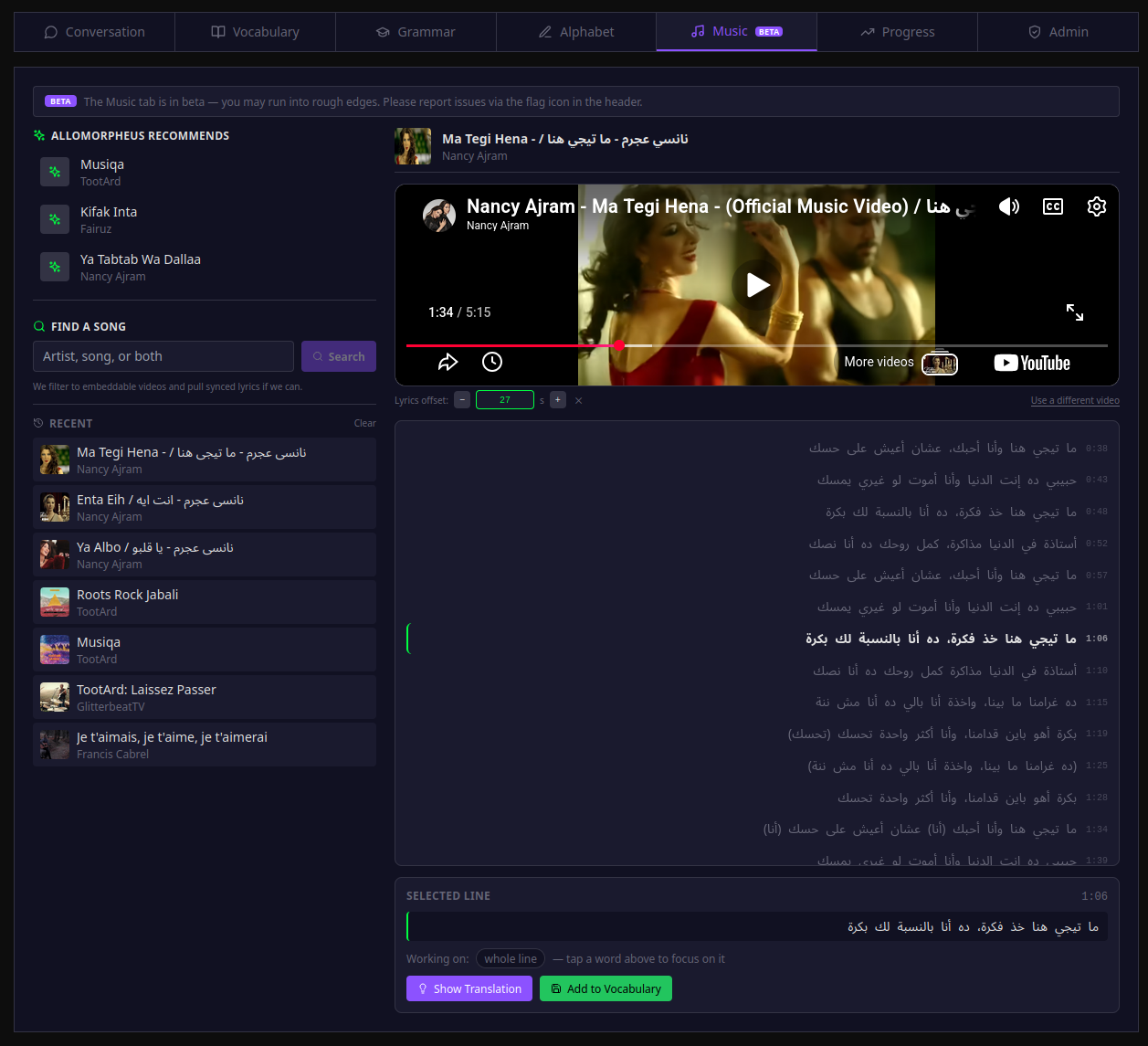
> MY ACTUAL MUSIC STUDY WORKFLOW
Here's the workflow I actually use. It's built to squeeze the phonological, vocabulary, and grammar benefits out of a song while avoiding the classic trap: passive listening, where you feel like you're studying but the audio is really just washing over you.
01. SELECT A SONG YOU CANNOT STOP THINKING ABOUT
This is the most important step, and it's not negotiable. Pick a song you genuinely love. Not one you feel you “should” study, and definitely not a simplified classroom song. A real song you'd listen to anyway if the lyrics were in English. The emotional pull is what powers the repetition — and if you don't love the song, you won't play it enough times for the phonological bootstrapping to kick in.
I look for clear vocal delivery: no heavy auto-tune, no mumble-rap, nothing deliberately slurred. Pop ballads, folk, and singer-songwriter stuff work well early on. Hip-hop is great once you're intermediate — the denser rhythm gives you even more to latch onto.
02. FIRST LISTEN — PURE AUDITORY
Before I look at any text, I listen two or three times, audio only. I'm not trying to understand anything. I'm letting my brain build a first acoustic model of the song — the phrase rhythms, the pitch shapes, the stress patterns. Call it phonological orientation.
It works better than you'd expect. After a couple of passes I can usually tell where every phrase boundary falls, even without knowing what the words mean. Segmentation has already started.
03. WATCH THE VIDEO — AUDIO + VISUAL
Then I watch the video a few times. Still no lyrics — just audio plus pictures. This is where the semantic scaffolding kicks in. The visuals tell me the topic, the mood, the rough story. If the video shows a couple breaking up, I know the lyrics are about loss or longing before I've understood a single word.
That head start matters more than it sounds. Knowing the theme shrinks the search space when I finally see the text, so matching words to meanings goes much faster.
04. LISTEN WITH SYNCED LYRICS
This is the core of the whole method. I load the song with synced lyrics — each line shows up in time with the audio, highlighted as it plays. I listen at least three times, with a different job for each pass:
Pass 1: Segmentation. I match what I hear to what I see. Was that one word or two? The text settles it. I notice where sounds get squashed together — liaison, elision, assimilation — and compare that to the spelling.
Pass 2: Meaning. I use the in-line translations or tap words I don't know. No memorizing yet. I'm just building a first map from forms to meanings for the song's key vocabulary.
Pass 3: Structure. Now I watch the grammar. How do the verb forms change across the song? Does the chorus do something different from the verses? Which little words and endings keep showing up?
05. SAVE VOCABULARY TO YOUR LEXICON
After those passes, I save the words and phrases that stood out. Not every unknown word — that way lies madness. I save the salient ones: the chorus lines I already half-know, the verbs carrying the emotional weight, the idioms that show up in real speech.
One detail matters a lot here: every word gets saved with its context — the line it came from, the song, the date. That's what makes review work later. When spaced repetition brings the word back, it comes back with the original line, and the whole multisensory memory wakes up with it.
06. EXPORT TO ANKI FOR SPACED REPETITION
At the end of the week, I export my accumulated music vocabulary as a single Anki deck. One click. Each card has the word, the song line, the translation, and an audio clip of the line. Reviewing those cards brings back the whole experience — the melody, the scene, the mood.
That beats generic Anki cards by a mile, because the retrieval cues are multimodal and personal. You're not recalling a translation. You're recalling a moment.
07. DEPLOY IN CONVERSATION
Last step: use the words. I talk about the song with the AI tutor — why I like it, what the lyrics mean, how it makes me feel. That moves the vocabulary from recognition (I know this word when I hear it) to production (I can use it somewhere new).
That's the whole cycle: multisensory encounter → capture → spaced repetition → conversation. Skip steps 5 through 7 and music study is fun but inefficient. Run the full loop and it's one of the strongest tools in the kit.
> LANGUAGE-SPECIFIC ADVANTAGES OF MUSIC STUDY
Different languages come with different sound challenges, and music happens to help with each of them in its own way.
Tone languages (Mandarin, Thai, Vietnamese). In a song, tone is baked into the melody. A Mandarin third tone — that dipping contour that's hard to catch in fast speech — becomes obvious when it's part of the tune. Honestly, I think this is one of the best ways to train tone perception, better than minimal-pair drills, because the melody gives the tone something to hang on to.
Pitch-accent languages (Japanese, Swedish, Serbo-Croatian). Here, pitch patterns distinguish words: hashi with a high-low pitch means “chopsticks,” low-high means “bridge.” In a song, those pitch patterns ride on the melody, so you hear them clearly. Listen to enough J-pop with synced lyrics and the pitch accents of common words sink in without any drilling.
Stress-timed languages (English, German, Russian, Arabic). These languages hit stressed syllables at roughly regular intervals. Learners coming from syllable-timed backgrounds (Spanish, French, Japanese) often struggle with the squashed unstressed vowels — the famous English schwa. Music exaggerates the stressed-versus-unstressed contrast, so full vowels and reduced vowels start to sound like genuinely different things.
Morphologically rich languages (Finnish, Turkish, Arabic, Plains Cree). In these languages, one word can do the work of a whole English sentence by stacking morphemes. Lyrics tend to use simpler forms than formal writing, but the chorus repeats its complex forms over and over — pattern exposure, in context. A Finnish learner who has heard rakastan sinua (I love you) in a chorus a dozen times has absorbed the first-person -n ending through sheer repetition.
> THE TRANSFER TO REAL-WORLD COMPREHENSION
Fair question: does any of this transfer to real-world listening, or is it just a pleasant way to feel productive?
The evidence is better than you might expect. Work on melodic intonation therapy — originally developed for aphasia patients — has been adapted for second-language learning, and melodic priming reliably improves phoneme discrimination, word recognition, and sentence comprehension. And the effect doesn't stay inside the songs: learners doing structured music study also get better at understanding plain, unscripted speech.
The mechanism is perceptual attunement, which is a fancy way of saying your auditory system is trainable. It can learn to hear distinctions your first language doesn't make, and repetitive, prosodically exaggerated musical input speeds that training up. You end up hearing the difference between Hindi's aspirated and unaspirated stops, or German's tense and lax vowels — not because you drilled them, but because the music made them audible.
Here's my practical claim. Do structured music study for 30 days — the workflow above, 15–20 minutes a day — and you'll notice a real improvement in how much spoken language you understand, musical or not. The phonological model you built on songs transfers to the street.
> WHY THE RIGHT TOOL MATTERS
Could you do this workflow with a YouTube video and a notebook? Sure. Sync the lyrics yourself, pause and rewind for every word, write it all down by hand, build your Anki cards one at a time. I did exactly that for years, and it works — but it's fragile. The friction of manual capture kills the habit within a week, and juggling YouTube, a translator, a notebook, and Anki eats the attention the music was supposed to free up.
That's why Allomorpheus has a dedicated music study tool. Paste a YouTube link and it:
— Pulls in the video and syncs the lyrics to the audio automatically.
— Shows the lyrics with in-line translations, highlighting each line as the song plays.
— Lets you tap any word or phrase to save it to your lexicon, with the song line attached as context.
— Sends every saved word into the same spaced-repetition pipeline as words from conversations, articles, and grammar lessons.
— Exports your music vocabulary as a ready-to-use Anki deck in one click, audio clips and song lines included.
The platform removes the friction. The music does the immersing. Your brain does the learning.
> TUNE YOUR EAR BEFORE YOU TRY TO SPEAK
Understanding comes before speaking. That's how first languages work — babies understand words months before they say any — and second languages are no different. The most common mistake I see is pushing to speak before your ear is ready. The phonological, lexical, and grammatical patterns haven't settled in yet, so the output comes out halting and error-ridden, and every conversation just rehearses bad habits.
Music offers a more patient path. Let the rhythm handle segmentation. Let the melody tune your ear to the prosody. Let the synced lyrics be your scaffold. Build your vocabulary from songs you actually love, and let the multisensory bundle create memory traces no flashcard can match.
The speech will come. But first, tune your ear.
7 days free — no credit card required
> Read more: My language learning workflow | Anki for language learning | AI language learning app